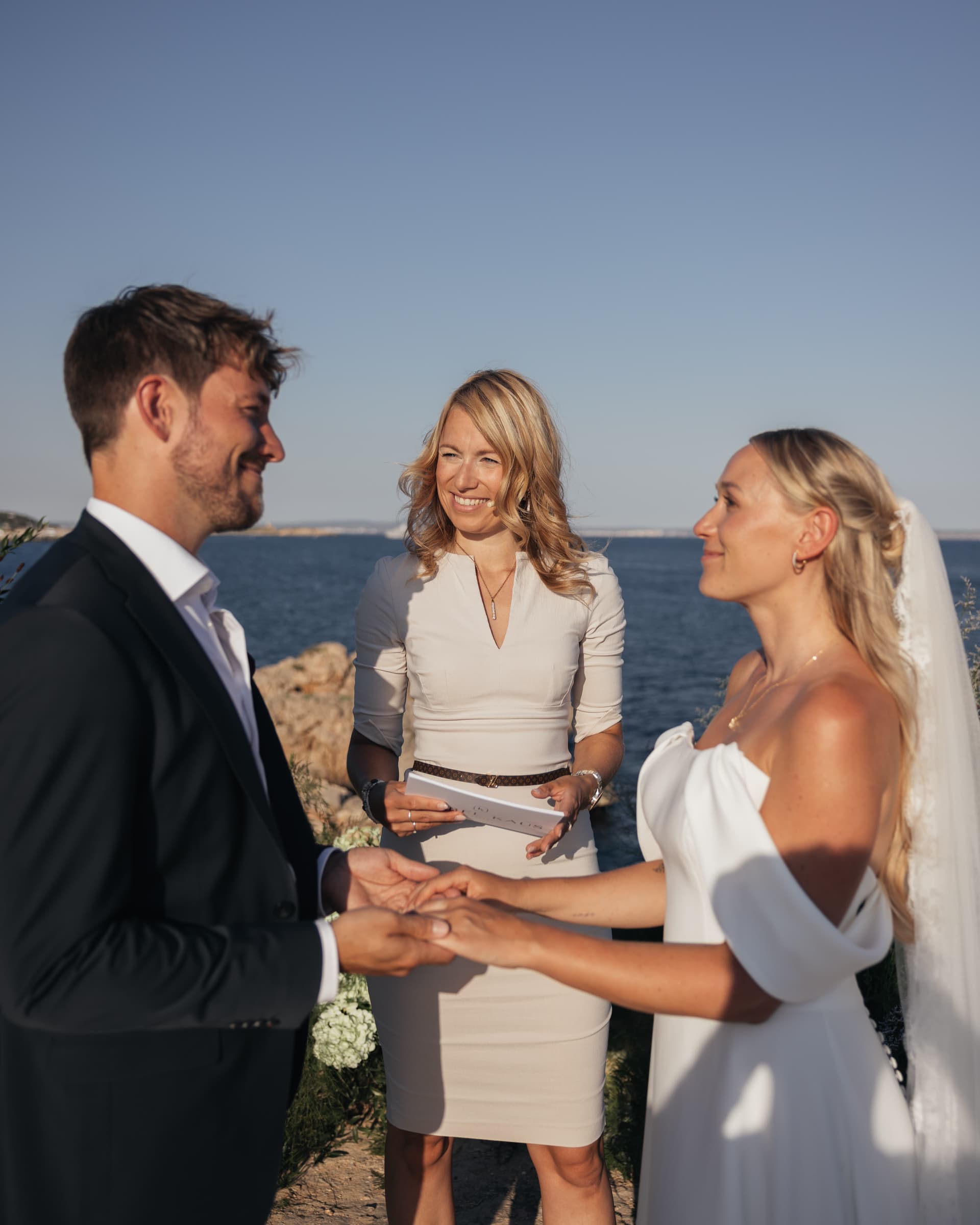
Getting married in Mallorca as a foreigner means choosing either a legal marriage completed in Spain or a symbolic Mallorca ceremony after the legal marriage is completed elsewhere. The symbolic route gives most destination couples greater control over timing, language, venue, and guest experience, while a Spanish legal marriage requires individual confirmation of documents and eligibility. Spain’s legal marriage process is widely described as complex, and many couples separate the legal act from their island celebration. Wise explains this distinction for couples marrying in Spain.
Key Takeaways:
- A legal marriage in Mallorca and a symbolic Mallorca wedding are different planning projects.
- Confirm your legal route before booking a finca, writing ceremony wording, or inviting guests.
- Judge venues by access, guest flow, sound arrangements, and a credible weather alternative—not images alone.
- A multi-day Mallorca wedding needs distinct purposes for each gathering and realistic transfer plans.
- As of 2026, personal legal requirements still need direct confirmation from the relevant authorities or qualified advisers.
Last updated: September 24, 2026
Table of contents
- What is getting married in Mallorca as a foreigner?
- Which marriage format fits a Mallorca destination wedding?
- decision criteria for getting married in Mallorca as a foreigner
- What operational workflow keeps a Mallorca wedding on track?
- How should a Mallorca finca be assessed before booking?
- What does the ceremony format change for international guests?
- Which Mallorca wedding examples clarify the right route?
- What are the costs and benefits of separating legal and celebration plans?
- What risks and limits deserve attention before guests travel?
- What checklist should foreign couples complete before booking?
- When is Frech Weddings not the right choice?
- Common questions (FAQ) about getting married in Mallorca as a foreigner
What is getting married in Mallorca as a foreigner?
Getting married in Mallorca as a foreigner is the process of arranging a legally recognised marriage on the island or hosting a Mallorca ceremony that celebrates a marriage completed elsewhere. The central question is not simply nationality. It is whether the ceremony in Mallorca must create the legal marriage or serve as the personal, public celebration of it.
A legal ceremony is both an administrative and personal event. A symbolic ceremony is a non-legal wedding ceremony shaped around the couple’s choices of location, speakers, music, readings, and language. This distinction determines the planning sequence, the people who need to be involved, and the information guests need before travelling.
As of 2026, legal eligibility, document requirements, translations, certifications, and recognition in a home country remain individual matters. General guidance is useful for framing questions, but it does not replace advice for a couple’s nationality, marital status, and intended form of ceremony. Keep legal verification separate from venue and creative planning.
This article addresses the basics about what you need to make getting married in Spain a reality, from the legal requirements and documentation, to estimates on costs and popular venue recommendations. We’ll also mention some Spanish wedding traditions you might want to include in your ceremony. Although Spain is a stunning wedding destination, the legal process of getting married there can be quite complex. Some couples opt to marry in their home countries and simply host a Spanish celebration, while others are determined to navigate the local requirements and have their official ceremony there. Source: Getting married in Spain - A complete UK guide.
Which marriage format fits a Mallorca destination wedding?
The first decision is whether Mallorca must host the legal act of marriage. Make that choice before selecting a wedding venue, confirming flights, or drafting invitations. A clear format prevents a common planning failure: building a complete guest experience around assumptions that do not match the legal route.
Spain offers a compelling setting for a destination wedding, yet the legal process can be demanding. The available guidance notes that some couples marry in their home country and then host the Spanish celebration separately, preserving Mallorca as the setting for the emotional centre of the wedding. That separation is outlined in this overview of marriage in Spain.
| Option | Good fit | Decision question | Main limitation |
|---|---|---|---|
| Legal marriage in Mallorca | The legal act must occur on the island | Have personal legal requirements been confirmed? | Administrative steps shape the ceremony plan |
| Legal marriage at home and symbolic Mallorca ceremony | The guest experience and ceremony design are the priority | Can the civil appointment happen before travel? | The Mallorca ceremony is not the legal act |
| Private Mallorca elopement | A small, intimate celebration is intended | Does the setting offer privacy and simple movement? | The experience has limited space for a wider guest group |
| Multi-day Mallorca celebration | Guests are travelling for a shared island stay | Does every gathering have a clear purpose? | Transfers and timing become central decisions |
Choose the legal and celebration format before building a venue, supplier, and schedule brief.
A symbolic Mallorca ceremony is not a reduced version of a legal wedding. It is a ceremony with a different purpose: the couple can focus the island day on their vows, community, setting, and shared experience while the legal registration follows the route they have individually confirmed.
decision criteria for getting married in Mallorca as a foreigner
The decision criteria for getting married in Mallorca as a foreigner are legal clarity, guest movement, venue operations, ceremony design, and the amount of travel a group can comfortably absorb. A strong plan resolves these five criteria in that order. A picturesque concept without them is vulnerable once guests, suppliers, and weather enter the picture.
- Legal route: decide whether Mallorca hosts the legal act or a symbolic ceremony.
- Guest profile: account for ages, mobility, languages, arrival times, and confidence with unfamiliar travel.
- Venue operation: assess access, ceremony position, dining areas, sound conditions, and an alternative setting.
- Schedule rhythm: allow for transfers, meals, shade, greetings, and pauses rather than stacking every hour.
- Creative intention: define whether the day should feel formal, intimate, editorial, relaxed, or celebratory.
For a Palma de Mallorca wedding, guest movement often centres on hotels, city streets, and dinner locations. For a finca near Llucmajor, Calvià, or Sóller, the crucial factors shift to road access, arrival timing, outdoor comfort, and the path between ceremony and dinner. The location type changes the operational problem.
What operational workflow keeps a Mallorca wedding on track?
The operational workflow for getting married in Mallorca as a foreigner begins with the legal route and ends with a shared run-of-show. Each stage should settle a decision that affects the next one. Booking first and defining the ceremony format later forces suppliers to work around an unresolved foundation.
- Confirm the legal route through the relevant authorities or qualified advisers.
- Write a one-page event brief covering guest count, ceremony type, languages, atmosphere, and privacy needs.
- Assess possible venues across arrival, ceremony, drinks, dinner, and departure.
- Build a schedule around travel time, meals, daylight, comfort, and unhurried transitions.
- Share one final schedule with the venue, transport, officiant, and creative team.
As of 2026, the practical advantage of this sequence is accountability. Legal questions remain with legal advisers, operational questions remain with the venue and transport providers, and creative decisions remain with the couple and their chosen specialists. No supplier should be expected to imply an answer outside their role.
A useful run-of-show contains exact meeting points, departure windows, ceremony start time, dinner timing, and the weather alternative. It also identifies one person who can answer guest questions on the day. That clarity protects the couple from spending their ceremony afternoon coordinating arrivals.
How should a Mallorca finca be assessed before booking?
A Mallorca finca is a rural property used as a wedding setting, and it should be assessed as a working event environment rather than a photographic backdrop. The right finca supports how guests arrive, gather, hear the ceremony, eat, move after dark, and leave. Visual character matters, but it cannot compensate for poor circulation.
Walk the property as a guest would. Notice where vehicles stop, where people wait, whether older relatives can reach the ceremony area comfortably, and how guests move from drinks to dinner. In coastal and rural Mallorca, the ceremony area also needs practical consideration for shade, wind, uneven ground, and footwear.
- Arrival: identify drop-off points, parking arrangements, signage, and the walking distance to the welcome area.
- Ceremony: check sightlines, seating, sound, shade, and the route for the couple and officiant.
- Reception: examine the distance to drinks, dining, restrooms, and any evening gathering area.
- Weather alternative: ensure the alternative space is suitable for the ceremony and not merely available.
Community discussions about Mallorca weddings repeatedly focus on the practical fit between venue, guest count, and multi-day plans. A discussion of a three-day Sóller celebration, for example, centres on venue and programme decisions for a group of about 100 people. That Mallorca destination-wedding conversation illustrates why logistics need early attention.
What does the ceremony format change for international guests?
Ceremony format determines the emotional structure of a destination wedding. A legal ceremony follows the form required to establish the marriage. A symbolic ceremony lets the couple choose who speaks, which languages are used, how family participates, and how much time the central moment needs.
For guests arriving from different countries, bilingual ceremony design is a practical form of hospitality. Short transitions between languages, carefully selected readings, and clear introductions help everyone follow the meaning without turning the ceremony into a sequence of repeated explanations. The aim is inclusion, not length.
As of 2026, Mallorca remains visible as a setting for extended celebrations rather than a single ceremony alone. A recent local report on a Mallorca wedding and post-wedding celebrations reflects the appeal of building an island programme around more than one gathering. The report provides a current example of a wedding followed by additional Mallorca events.
Which Mallorca wedding examples clarify the right route?
Concrete cases clarify the choices involved because every format starts with a different priority. The right Mallorca wedding route is the one that keeps legal administration, guest comfort, and creative ambition in proportion. More complexity is not automatically more meaningful.
Case one: civil marriage at home, ceremony at a finca
A couple completes the legal marriage in their home jurisdiction, then welcomes 60 guests at a finca for a symbolic ceremony and dinner. Their ceremony includes two languages, personal vows, and readings from siblings. This format works because the Mallorca day is free to follow the group’s pace rather than an administrative appointment.
Case two: a three-day Sóller gathering
A couple hosts a welcome meal on the first evening, a wedding day without long inter-venue transfers, and a relaxed beach gathering on the final day. Each event has a separate mood and purpose. This model suits guests travelling internationally because the celebration unfolds across several manageable moments rather than one compressed schedule.
Case three: a private elopement near Palma
A couple plans a short symbolic ceremony, a private meal, and portrait time around changing light. The legal step is completed separately. This approach fits couples who value privacy and do not want the day to become a production of constant location changes, staged activities, or rushed photographs.
What are the costs and benefits of separating legal and celebration plans?
Separating the legal marriage from the Mallorca celebration changes where effort is spent, not the importance of the wedding itself. The legal route concentrates attention on eligibility and documents. The symbolic route concentrates effort on venue operations, ceremony content, guest travel, and the quality of the shared experience.
| Planning route | Where the effort goes | Benefit | Trade-off |
|---|---|---|---|
| Legal marriage in Mallorca | Personal documentation, appointments, and legal confirmation | Legal and ceremonial act occur in one place | Administration can constrain timing and format |
| Legal marriage at home, Mallorca ceremony | Guest experience, venue coordination, and ceremony design | Clear separation between legal and celebratory work | Requires two distinct milestones |
| Elopement | Privacy, location, and a calm schedule | Fewer moving parts and more uninterrupted time | Not designed for a large guest experience |
| Multi-day celebration | Transfers, accommodation information, and programme pacing | More time with travelling guests | Greater coordination across several events |
Compare planning routes by where effort is required and what the couple wants the Mallorca experience to accomplish.
Do not judge value through a single headline cost. Compare proposals and choices through coverage, inclusions, travel demands, backup arrangements, and the consequences of changes. A modest plan with clear guest movement and a credible alternative setting often protects the experience more suitable than a visually ambitious plan with no operational margin.
What risks and limits deserve attention before guests travel?
The main risks in getting married in Mallorca as a foreigner arise when legal, logistical, and creative decisions are blurred together. A venue confirmation does not answer a legal question, and an attractive ceremony concept does not solve guest transport. Assign each decision to the person or organisation responsible for it.
Weather planning is a core design choice. It affects ceremony placement, dinner layout, clothing, lighting, guest comfort, and photography. A real alternative setting should feel intentional and workable, with sufficient space, access, seating, and sound conditions for the same people expected at the original ceremony location.
Travel is another limit. Guests experience transfers, unfamiliar roads, waiting periods, arrival instructions, and uneven surfaces—not a map pin. Send concise information that explains where to meet, when to depart, what footwear is appropriate, and who can help if an arrival is delayed. Local traveller discussions also show why venue-specific questions matter before commitments are made. A Palma de Mallorca forum thread reflects the practical questions couples raise about weddings on the island.
As of 2026, the cleanest safeguard is to treat general online material as orientation rather than a personal ruling. Confirm facts that affect legal status directly for your own circumstances. That discipline keeps the celebration from carrying uncertainty that belongs in the verification stage.
What checklist should foreign couples complete before booking?
A Mallorca wedding checklist is useful only when it turns the major decisions into clear confirmations. Complete the legal and operational items before paying deposits that depend on them. The goal is not paperwork for its own sake; it is preventing an avoidable conflict between the ceremony you want and the plan you have booked.
- Have we decided whether Mallorca hosts a legal or symbolic ceremony?
- Have we confirmed personal legal requirements through the relevant channels?
- Does the venue work for arrival, ceremony, dinner, sound, and a weather alternative?
- Does the schedule include realistic travel time and time for guests to settle?
- Have we planned clear communications for transport, footwear, timing, and contact details?
- Does the ceremony language include all key guest groups?
- Do suppliers have one current run-of-show and one point of contact?
Use the checklist again shortly before travel. A decision that was clear during venue research can become vague after menus, transport, guest replies, and supplier schedules are added. Rechecking the sequence protects the day’s calmer moments: arrivals, the ceremony, dinner transitions, and time with the people who travelled.
When is Frech Weddings not the right choice?
Frech Weddings is relevant when a couple wants a Mallorca wedding documented with an editorial sensibility and close attention to real interactions, changing light, and the movement of the day. Photography is strongest when it is considered alongside the ceremony timeline and location sequence, rather than added after every decision is fixed.
It is not the right choice when the immediate need is legal advice, venue licensing, guest transport management, or a purely administrative service. It is also not a fit for a schedule that leaves no time for people to arrive, connect, and experience the celebration without constant direction. Those foundations need to be resolved first.
Once the legal route, venue logic, and core timeline are clear, couples seeking this visual approach can review Frech Weddings’ wedding photography approach and decide whether it matches the atmosphere they want recorded.
Common questions (FAQ) about getting married in Mallorca as a foreigner
These answers summarize the practical decision points for getting married in Mallorca as a foreigner in a concise format.
Can foreigners get legally married in Mallorca?
Foreigners should confirm legal eligibility for their individual circumstances before planning a legal Mallorca ceremony. Spain’s marriage process can be complex, so nationality, documents, marital status, and intended legal route need direct verification.
Is a symbolic wedding ceremony in Mallorca meaningful if we marry legally elsewhere?
Yes. A symbolic ceremony is the personal and public expression of the marriage, with freedom over the setting, language, vows, music, and participants. It is a different format from a legal ceremony, not a lesser one.
Can we hold a bilingual ceremony in Mallorca?
Yes. Use concise transitions, selected readings, and clear introductions so guests can follow the meaning in both languages. A bilingual ceremony works suitable when translation is built into the structure from the beginning.
How do we choose between Palma and a Mallorca finca?
Choose Palma when city access, hotels, and walkable logistics matter most. Choose a finca when privacy, landscape, and an all-in-one ceremony and dinner setting matter more, provided the property works operationally for your guests.
What should guests know before attending a rural Mallorca wedding?
Guests need exact transport instructions, realistic departure times, surface and footwear guidance, and a contact person for day-of questions. Clear information reduces late arrivals and prevents avoidable discomfort at an outdoor location.
Do we need a weather alternative for a Mallorca outdoor wedding?
Yes. The alternative should be a fully workable ceremony and reception space, with seating, access, sound, and a clear setup plan. Treat it as part of the design rather than an emergency afterthought.
How many events should a multi-day Mallorca wedding include?
Include only gatherings with a distinct purpose, such as a welcome meal, wedding day, and relaxed farewell. A smaller programme with time to rest and travel well creates a stronger guest experience than a crowded schedule.
When should we book a Mallorca wedding photographer?
Book after the legal route, venue direction, and rough day structure are clear. Those decisions determine coverage needs, portrait timing, travel between locations, and whether the photographer’s approach fits the celebration.